



 Gian Piero Matarazzo
Technical Analysis of Opera V v2 Speakers
The new Opera Quinta V2 traces, in configuration, the previous model even though it is a generous as well as inconspicuous upgrade. Thanks to a careful study of the speaker’s individual components we were able to exceed the 87-88 dB sensitivity limit, even reaching 91 decibels, which guarantees the use of low-power amplifiers, excellent dynamics and a very linear performance even at high levels. The load seen by the amplifier, thanks to low phase rotations, does not appear critical at all, ensuring good driving even with amplifiers of limited power.
Opera V v2: the mobile
As with the Prima V2, the utmost attention was paid to the internal design of the cabinet and the removal of all possible coloration that this adds to the message sent to the speakers by the amplifier. The midrange operates in a totally closed volume, with a resonant frequency less than half the effective crossover frequency so that it has a considerable reserve of power even below its playback range. The midrange box features a strongly sloped back wall to deflect reflections on the absorbing material covering the inner walls. The polyurethane absorbing material was chosen with a special density so as to attenuate all internal reflections as much as possible. Of course, the absence of vibration on the side walls was checked with the utmost care, which was reduced by two reinforcements placed at the right places.
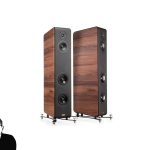
Opera V v2: the speakers
Again, the drivers were optimized through a fruitful collaboration between OPERA and Scan-Speak to achieve a good balance between damping and power handling, with the special feature of having a bass presence even at very low volumes. The nominal 18-cm drivers are bass reflex loaded in a fairly large cabinet with a very low tuning frequency due to two ducts arranged at the rear and sized to have low turbulence even at high pressures. These are two 18-cm drivers with a construction tolerance of less than 3 percent quite similar to the one that equips the OPERA Prima V2 but are connected in series with each other so as not to lower the impedance modulus too much with extremely small tolerances so that there are no noteworthy deviations in either the reflex or filter-seen load. The amplifier sees a fairly high minimum, above 6 ohms with little phase rotation, so that it can be considered an extremely easy load for the amplifier.
The midrange, which is in charge of voice reproduction, works from 230 to 2300 Hz thanks to a fairly simple band-pass filter electrical network due to the remarkable linearity of the midrange diaphragm, which is made from a special fiberglass processing. Despite the apparent simplicity, the acoustic response of the midrange has a high slope. The shrewd choice of the midrange’s high-pass components allows for a double slope so that the acoustic phase is perfectly in tune with the phase of the two woofers below.
The tweeter is practically the same component used on the OPERA Prima V2, which starts from a stock transducer to which only the moving crew has been reinforced, capable of holding considerable power at low distortion. The Danish manufacturer’s hand-treated soft dome allows for a low-fatigue and particularly extended high end.

Opera V v2: the crossover
As we have seen, the design of the crossover appears quite simple while still distinguishing between the electrical response at the speaker terminals and the actual acoustic response of the components, which then represents what we hear. The low pass of the two woofers also has a particular slope so that it can blend with the midrange response and have a virtually coincident acoustic phase. The high sensitivity of the unit allowed us to “modulate” the tuning frequency and obtain an extended but very well damped bass. The slopes of the three filter networks, although very mild, ensure a high slope so as to maximize the cleanliness and articulation that the speakers can express. It should be noted that the acoustic phases of this three-way are particularly close throughout the frequency range reproduced by the midrange, both in on-axis and off-axis detection. This ensures good resolution of voices with excellent sound stage design.
Gian Piero Matarazzo




GIPHY App Key not set. Please check settings