

 Audio 2G
TheAdvance Paris A 10 Classic, the protagonist of this review, confronts us with a question: the vast majority of integrated amplifiers produced today have a section of a few analog inputs-sometimes a phono section-of digital inputs often with streaming capability. The interesting thing is that in this area the variability of prices is truly astounding: they range from a few hundred euros to several tens of thousands. It goes without saying that the quality of the proposals is also enormously variable, which makes it difficult to define unambiguously where the line between “gadget” and true Hi-Fi lies. Today, with the Advance Paris A 10 Classic, we test an integrated amplifier that combines several aspects, some of them even contradictory, in a product that – on closer inspection – stands out from the competition.
Advance Paris
Advance Paris began operations under the name Advance Acoustic in 1995 in Toulouse with a range of five loudspeakers developed in France. After expanding the loudspeaker range, Advance Acoustic began working on electronic products in 2002, launching its first integrated amplifier in 2004. That product laid the aesthetic and technological foundation for Advance Paris products as we see them today. VU meters, valves, and massive cabinets are still in the brand’s DNA. These are products designed in France and made in China, as indeed the particularly competitive pricing suggests. The first Advance Paris-branded product was launched in 2013. The company began tackling the international market in 2005 and today sells its products in more than 40 countries.
Advance Paris A 10 Classic: Technique
Let’s start with the basic information: the Advance Paris A 10 Classic is an integrated amplifier of considerable size (mm 430 x 175 x 385 (WxHxD)) and weight (14.5 kg), operating in class AB delivering 130 W into 8 ohms and 190 W into four ohms. However, this concise information does not exhaust the many technological contents that characterize it, making it, in its own way, well distinguishable in a decidedly crowded market segment. Let’s see why.
Hybrid type
The first and most distinguishing feature from the competition is the preamplifier section, which does not use conventional solid-state active devices. As mentioned in the introduction, the French company prefers the use of thermionic tubes (valves) in several parts of its circuits, and the A 10 Classic is no exception, making use of a pair of dual ECC81 triodes in the preamplifier circuit. The choice is certainly not innovative, since there have been many examples of hybrid integrated amplifiers over the years. Incidentally, one of our references in Audio 2G is precisely a hybrid integrated amplifier, namely the Copland CSA 100. The motivation for this technical choice is based on the consideration that that particular part of the amplifier circuit works at low voltage and therefore a tube such as the ECC81, when used within its intended limits, offers more than satisfactory performance and a particularly pleasant “sonic signature” with a vaguely retro flavor. A characterization that is not undermined by the transistor power section which, in turn, provides the necessary delivery capacity to easily drive any load. In short, the hybrid typology, if implemented well, allows the best of both worlds to be combined. Returning to the Advance Paris A 10 Classic an additional distinguishing feature is the presence on the rear panel of a switch, called “High-Bias,” which allows Class A operation on the first watts. The user’s booklet does not specify how much the “first watts” concept amounts to, but I do not think we can assume more than five or six. However, let’s see what it is all about: analyzing the musical signal trend, on average the power utilization of an amplifier is limited to a few watts, reserving most of it for “peaks,” a situation in which the dynamic excursion requires more boost. That said, the A 10 Classic works precisely in Class A for the “first few watts,” while when higher powers are required the power stage switches to Class AB. However, in a device such as this 130 W/channel, this power is actually used only for short periods. This circumstance, combined with the possibility of varying the bias current just described, makes it possible to listen in Class A most of the time. Beware that in this mode the temperature of the unit will tend to rise slightly, so it is important to leave some free space around the amplifier so as to allow proper ventilation.
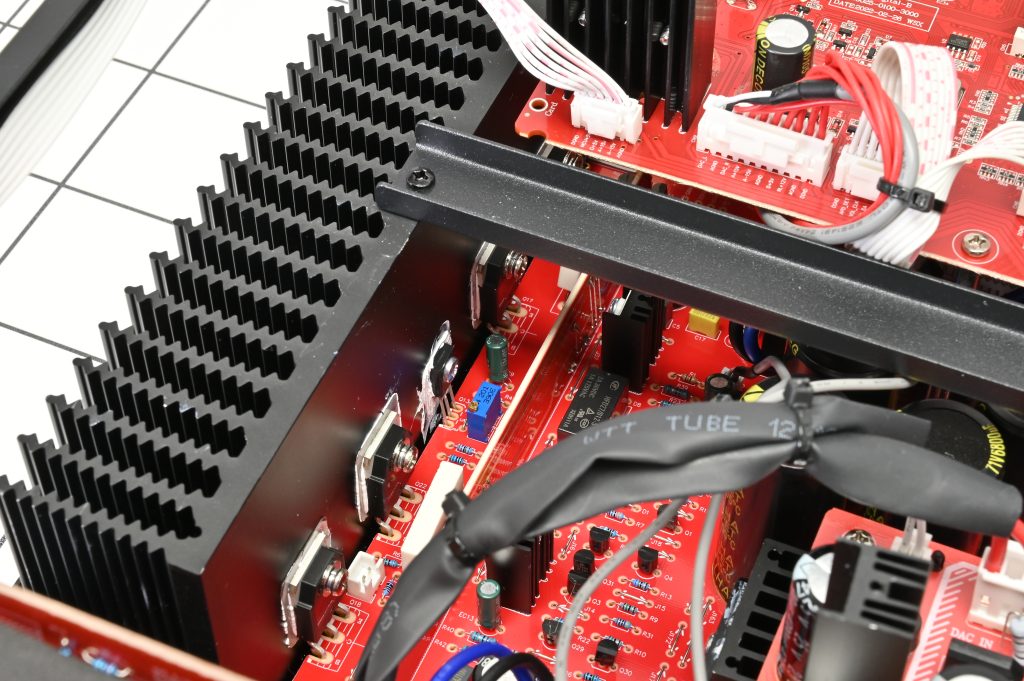
Analog connections
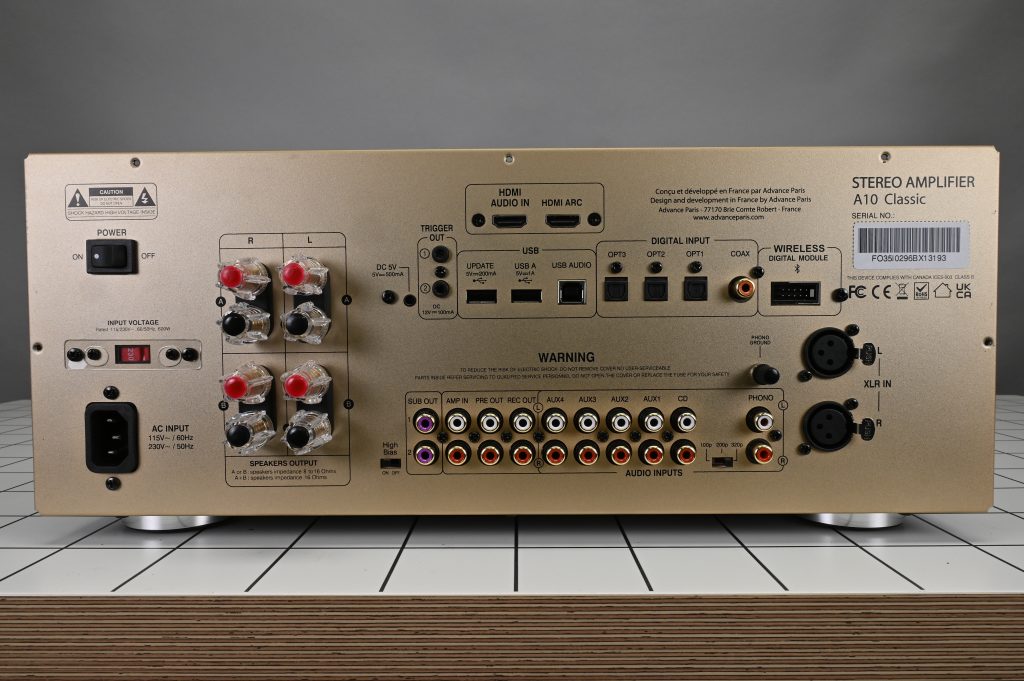
The analog connections section of the preamplifier section is remarkable: a balanced XLR connection is flanked by no less than five RCA line inputs and a moving-magnet phono stage that also offers capacitive load adjustment, a crucial factor in extracting the highest quality from the signal coming from MM cartridges.
In terms of outputs, the A 10 Classic has an AV bypass, a fixed-level REC output, a pre output, and a pair of subwoofer outputs with a 400-Hz non-adjustable filter. On the front panel is a 6.35 mm headphone jack that reports to a specific amplifier board.
Section digital
At the top of the rear panel of the Advance Paris A 10 Classic we find the digital input section that aims at least to achieve the same completeness as its analog counterpart. The chipset used is an ESS9038 capable of handling sample rates up to 384 kHz for PCM and DSD256, thus a more than adequate solution for most users. The digital board has one coaxial SPDIF digital input, three optical inputs and a USB-B connection that supports the maximum sampling rate allowed by the chipset. There is also a proprietary connection for the optional Bluetooth module, a choice I find absolutely agreeable and one that immediately increased my liking for this integrated amplifier.
So far, all in all, the features appear rather conventional although the presence of three optical inputs denotes considerable care on the part of Advance Paris. What impressed me positively are some additional connections. The first is the HDMI ARC input, not so common in this price range, but certainly welcome since it is easily conceivable to use this amplifier in conjunction with a TV in a home media center context. Next to this we find another HDMI connection capable of extracting audio from a compatible device such as, for example, the increasingly common DACs that use this sophisticated type of connection. On balance, the not inconsiderable number of 14 devices can be connected to the A 10 Classic, excluding Bluetooth. Now it is by no means certain that one has to use all of them, in fact it seems to me decidedly unlikely, however this equipment makes almost all other devices in the same price range offered by the competition significantly less equipped. There is no shortage of tone controls, loudness, IR triggers to turn on and off from additional electronics. The only thing I perhaps would have preferred would have been the possibility of direct input selection on the front panel, since switching from one source to another using the volume control, which also serves as a selector, and the small two-line alphanumeric display located at the bottom right, is rather cumbersome. Looking at the rear panel image, one will notice the absence of an Ethernet connection and antennas for Wi-Fi. In fact, the Advance Paris A 10 Classic, despite having an excellent DAC section on board, has no streaming capabilities. However, this apparent lack must be put in relation to the availability in the Advance Paris catalog of modules dedicated to these specific features. The power connectors to which the speakers are connected are two independently manageable pairs.
Advance Paris A 10 Classic: Construction
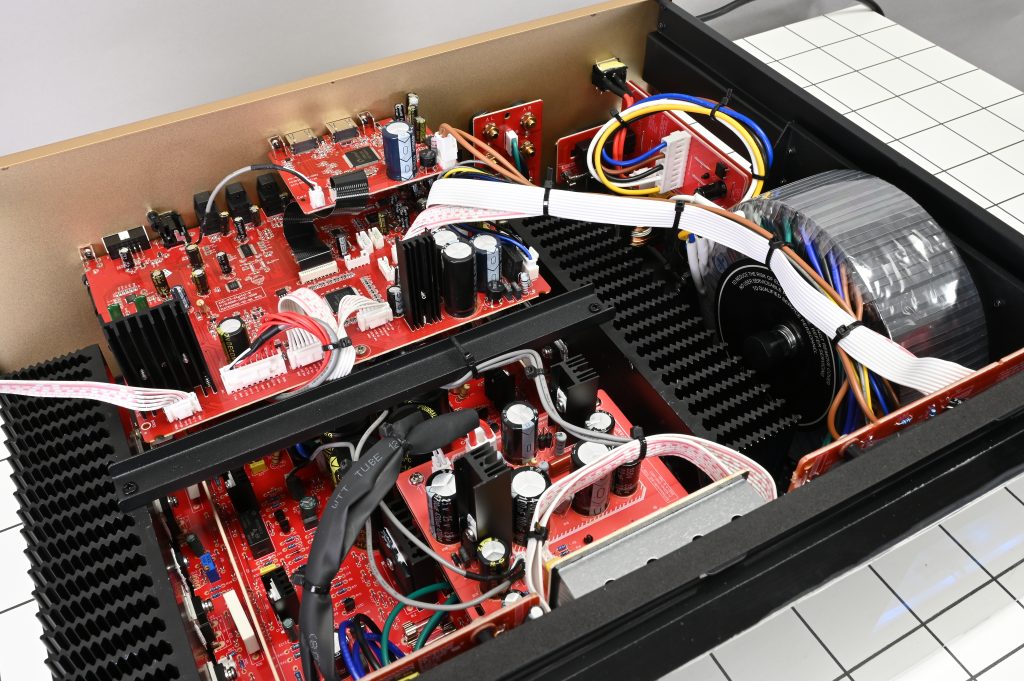
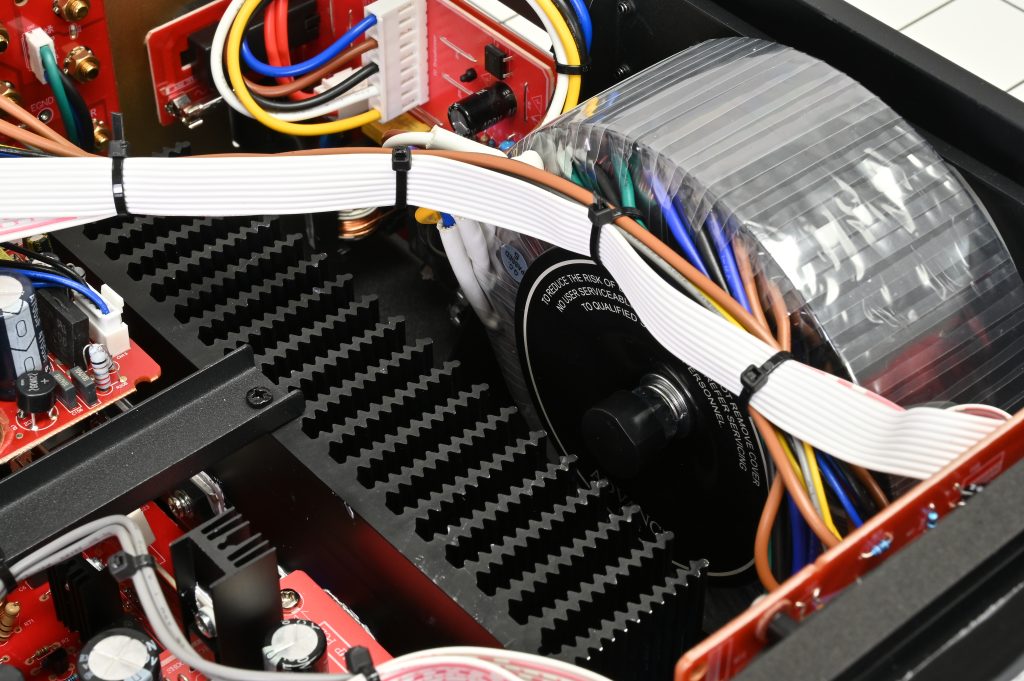
Looking at the inside of the Advance Paris A 10 Classic, one notices the huge toroidal transformer placed vertically that feeds the various sections of which the amplifier is composed. Another aspect to mention is the division into boards dedicated to the various functions, instead of using one large PCB as we are increasingly seeing nowadays. Thus we have one board dedicated to the phono section, one to the DAC section, one to the digital inputs section, etc. The various boards, colored red, are populated with good quality components.
Advance Paris A 10 Classic: Aesthetics and Finish
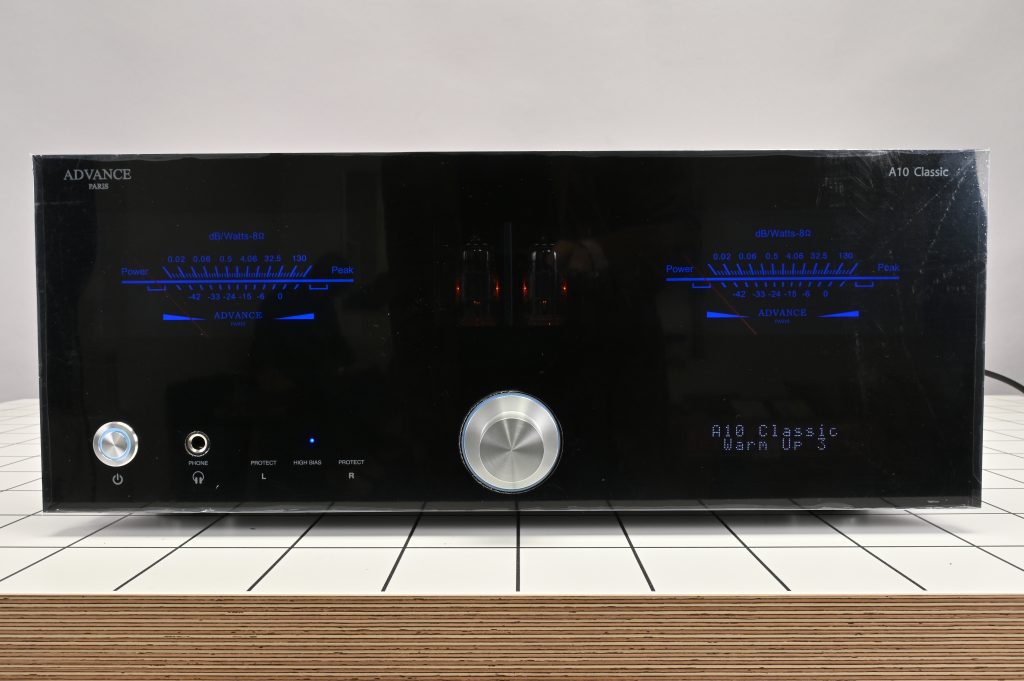
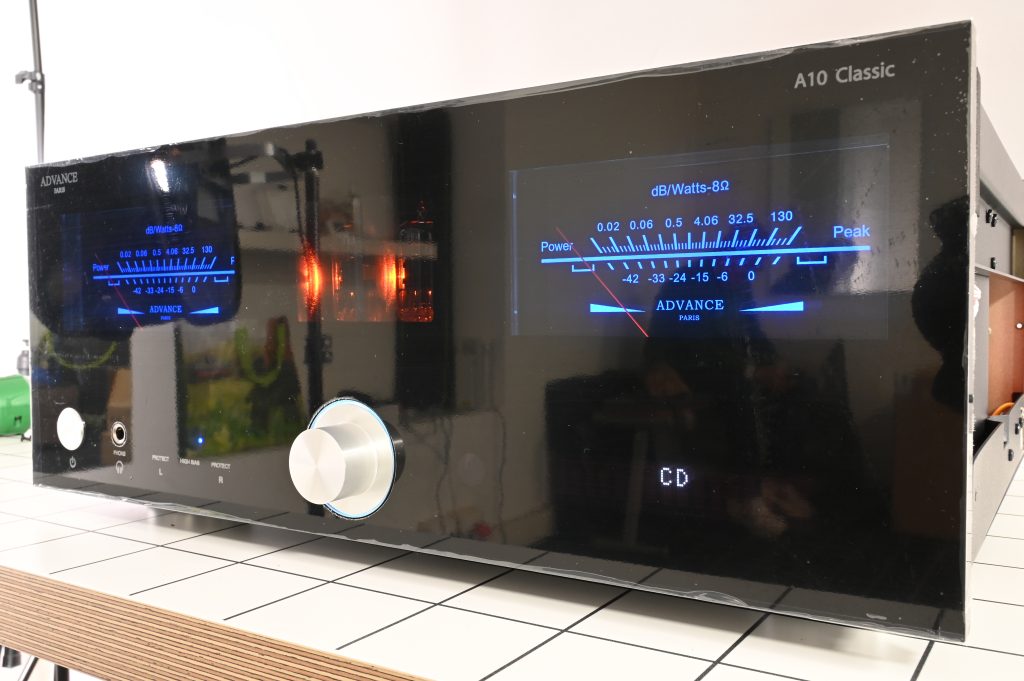
The previously mentioned volume control, which is actually a multifunction rotary encoder , is the only physical element with which the user interacts excluding the power/standby switch. It goes without saying that most of the interactions take place through the complete plastic remote control, which is rather well made although, like many other similar components, it suffers from a certain “overcrowding” of buttons due to the fact that it can be used with other products of the French manufacturer. At this point one should be able to guess how the aesthetic appearance of the Advance Paris A 10 Classic, has been designed in function of two elements that are certainly functional but also very aesthetically connoted: the central window that contains the valves and the two huge VU Meters.
As mentioned at the outset, this is an amplifier of considerable size: the width of 430 mm is standard, while the height of 170 mm is quite substantial. The stylistic choices also tend to emphasize mass rather than lighten it: the chrome volume knob and power button are the only two contrasting elements in a context completely dominated by the glossy black of the front panel and satin black of the cabinet walls. Inevitably then, the eye falls on the two elements mentioned earlier: the backlit window for the ECC81 tubes, which by their nature emit nothing but a dim glow, and the pair of VU meters that, instead of the traditional white/cream background, use a bold violet on a black background. Personally, neither element convinces me, finding the choice to keep the valve window perpetually illuminated in red, so even when the VU Meter’s dimming function is active, questionable to say the least, evoking an unnecessary Christmas atmosphere that not only feeds a kind of cliché inevitably associated with thermionic tubes, but it clashes with the glacial aesthetic of VU Meters. Regarding these devices, particularly the mechanical ones, I am aware that they are popular design elements for some users. However, I got the impression that those on the A 10 Classic were put there essentially to offer a visual indication of amplifier activity, lending a touch of dramatic expressiveness, rather than out of any real need.
Listening
An amplifier is heard, not looked at. So let’s leave aside the aesthetic considerations, which are personal and of limited value, and move on to the listening notes, which should put everyone in agreement. We paired the Advance Paris A 10 Classic with two pairs of speakers already tested on our channel: the Indiana Line Diva 6 and the Opera Prima V2. As a source, we used our Aqua La Scala MKII reference DAC and the New Horizon 301i turntable with an Ortofon 2M Bronze phono cartridge.
Let’s start with the DAC connected to the line input, playing from Qobuz a great classic of the symphonic repertoire: Smetana’s Vltava , conducted by J. Levine with the Vienna Philharmonic Orchestra (ed. D.G.). The flutes accompanied by the intermittent pizzicato of the violins, evoking the source of the great Bohemian river in the very first moments of the composition, are truly moving. The harmonic contrast between the two groups of instruments and the very fast forays of the violins are well portrayed, although in a context that avoids the spasmodic search for detail. After about a minute, when all the string groups, including the basses, enter and perform the main theme of the composition, the excitement is great. I believe that it is in these moments, characterized by dynamic contrasts, that this French integrated plays its best cards: the ability to adequately render the “solids” as opposed to the more delicate moments.
I turn to listening, again digitally, to some piano tracks performed by Danilo Rea on the album Lirico (2004, ed. Egea). It is a beautiful recording full of details, which the French amplifier succeeds in bringing out albeit in a context of general looseness, without ever “forcing the hand” toward analyticity as an end in itself.
Let us now turn to the phono input, putting the Birds vinyl by the Tingvall Trio on the platter. Here we can appreciate the substantial neutrality of the input, which does not impose any coloration on the sound, being well intelligible and consistently fast. Another note of merit concerns the quietness of this input, which for a phono is not always a given. The ability to handle capacitive loading, moreover, allowed us to interface our Ortofon 2M Bronze cartridge at its best.
Lorem ipsum dolor sit amet, consectetur adipiscing elit. Ut elit tellus, luctus nec ullamcorper mattis, pulvinar dapibus leo.
Conclusions
Our take on Advance Paris could not have been better. The A 10 Classic proved to be a modern integrated amplifier, complete in its equipment and, above all, excellent sounding. For an all in all modest outlay, one has the opportunity to come into possession of a versatile and well-built music machine, capable of satisfying both the novice and the more astute listener. Of course, for the more demanding audiophile the demands become more demanding, but I am sure that even for him the Advance Paris catalog will have something interesting to offer.
Giulio Salvioni
Declared technical specifications
- OUTPUT POWER 8Ω, 4Ω and 2.66Ω: 130W, 190W and 250W;
- OUTPUT LEVEL sbil.: (max vol.) 9 volts;
- FREQUENCY RESP: (+/-3dB) 20Hz – 80 kHz;
- DISTORTION: < 0.006% @1KHz/1W < 0.02%@32W;
- SIGNAL NOISE RATIO: HN 98dB;
- OUTPUT IMPEDANCE: 10KΩ;
- DAC: ESS9018;
- DIGITAL AUDIO PCM TRANSCIEVER: AK4118;
- USB/DSD RECEIVING INTERFACE
- * Optical input: 24bit – 96kHz PCM;
- * Coaxial input: 24bit – 192kHz PCM;
- * USB audio PCM input: 24bit/32bit 44.1kHz – 384kHz;
- * USB audio PCM input: 2.8 MHz (DSD64)-DOP/5.6 MHz, (DSD128)-DOP/11.2 MHz (DSD 256)-DOP;
- AC INPUT: 115/230V 50/60Hz
- MAX POWER CONSUMPTION: 900W
- DIMENSIONS: H. 175 x W. 385 x D. 430
- NET WEIGHT: 14.5 kg
- Settings: Treble, Balance, Bypass, Hi Bias switch, Bass, Volume
- VU-Meter: Yes
- Tubes: (2x) ECC81/12AT7
Price: €2,300.00
Distributor for Italy: MPI Electronic
To buy it on Amazon





GIPHY App Key not set. Please check settings